Product Strategy
Vision Board, Ideal Customer Profiles, User Personas, prioritized Feature List — produced by ProductXplorer and its specialist Splines.
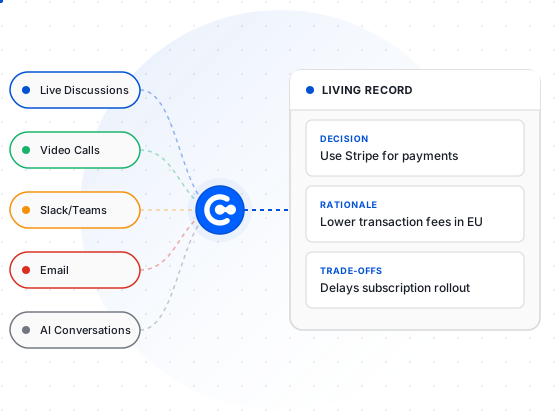
Your product vision starts in a conversation — a boardroom decision, a Slack thread, a Zoom call. Conntinuum's Splines — our specialized AI agents — show up wherever your team works and do far more than take notes. They ask the questions nobody thought to ask. They capture not just what was decided, but why.
They flag when a new decision conflicts with something agreed to six months ago. They surface relevant context from earlier in the product journey when it matters most. And they capture not just what was decided, but why — the rationale, the trade-offs, the strategic intent behind every choice.
Product development is long, complicated, and easy to lose the thread of. No single person on your team can hold the full context of every decision ever made. Your Splines can. Every conversation they join adds to a living record that's visible, traceable, and available to every stakeholder and every team member — from the first discovery session to the final sprint.
Nothing gets lost in translation. Nothing has to be re-explained. The institutional knowledge of your product lives in the system, not in someone's head.
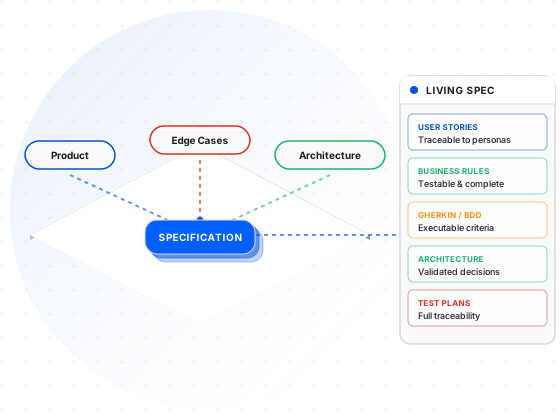
This is where Conntinuum diverges from every other tool on the market. From captured intent, your Splines produce a complete specification layer — feature requirements with testable business rules and executable Gherkin, system architecture validated against technical standards, data models, API contracts, security threat models, and comprehensive test plans. Every deliverable is interconnected. Every requirement is traceable. Every change propagates automatically.
Conntinuum's Splines don't just generate specifications once and hand them off. They maintain them. When intent evolves anywhere in the system — a decision made in a meeting, a refinement captured in a thread, a strategic pivot approved by leadership — that change propagates automatically across every connected deliverable: user personas, feature requirements, architecture decisions, acceptance criteria, test plans, and beyond.
Every artifact stays synchronized with the current truth of your product. No more chasing down which version of a spec is current. No more discovering mid-sprint that the requirements everyone was building from were updated two weeks ago and nobody told the team.
This is Spec-Driven Development. The specification isn't documentation you write after the fact. It's the artifact your product is built from.
This is what a genuinely living system looks like — not a document that gets outdated the moment it's written, but a specification layer that moves with your team, reflects reality at every stage of the journey, and ensures that every person building your product is always working from the same ground truth.
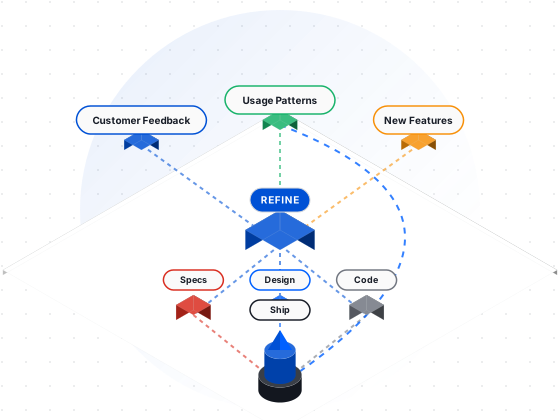
When specifications are this complete — with business rules, acceptance criteria, architecture decisions, data models, and test plans all interconnected — code generation stops being a gamble. Engineers aren't interpreting a prompt. They're implementing a specification that tells them exactly what to build, how it connects to everything else, and how to verify it works. CodeXplorer Splines generate code directly from these specs, producing implementations that are maintainable, testable, and traceable from the first commit.
But deployment isn't the finish line — it's where the feedback loop begins. Customer feedback, usage patterns, support signals, and new strategic decisions feed directly back into the system. Splines surface what users are actually asking for, reconcile it against your existing product context, and help your team make informed decisions about what to build next — and why.
Your product doesn't just ship. It compounds. Every release makes the next one smarter, faster, and more aligned with the people using it. Conntinuum doesn't hand you a finished product and walk away. It stays in the room for every conversation about what comes next.
This is the promise vibe coding tools make but can't deliver: fast software that's also good software. The difference is the specification layer underneath it.
Works where you work
Conntinuum meets your team where decisions and activity already happen.