
THE VIBE CODING CRISIS
The two most expensive mistakes in software development are building the right thing poorly, and building the wrong thing well.
70% of digital transformation projects fail to deliver what was promised. The root cause is rarely technical. It’s a context problem. A structural breakdown in how product intent gets captured, communicated, and maintained across teams and tools.
AI has made it faster to build. But for teams vibe coding solutions without a well documented strategy, poor architectural foundations, and a focus on speed over quality and maintainability, that means that mistakes compound faster.
The Intent Gap
A Problem Older Than AI.
Every software product begins with intent. A leader has a vision. A stakeholder defines a need. A customer describes a problem worth solving. That intent is clear in the moment it’s articulated — but from that point forward, it degrades.
A product manager interprets the intent and writes a requirements document. A designer interprets the requirements and produces specifications. An engineer interprets the specifications and writes code. At each handoff, nuance is lost. Rationale evaporates. Assumptions fill the gaps that context used to occupy.
By the time a product ships, the original intent has passed through multiple translations. The result is functional software that doesn’t quite match what was envisioned. Built correctly against a specification that no longer reflects the original decision.
This is the intent gap: the structural distance between what leaders decide and what teams build. It exists in every organization, at every scale, and it has been the primary driver of project failure in software development for decades.
These numbers describe a systemic failure in how product intent is preserved across the lifecycle of a project. The problem is not talent, process maturity, or tooling. It is the absence of a structural mechanism for capturing intent at its source and maintaining it as the single source of truth for every person and every tool involved in the build.
Conntinuum was designed to close the intent gap. The platform captures decisions where they’re made — in meetings, threads, and working sessions — and propagates them automatically to every downstream deliverable, ensuring that every team member builds from the same ground truth.
The Missing Layer
Vibe-coded software has no specifications. That's the problem.
Every tool promising to “build your app in minutes” shares the same fundamental flaw: they skip the specification. No requirements documents. No architecture decisions. No security threat models. No test plans. No traceability between what was asked for and what was built.
The result isn’t just technical debt. It’s an application that nobody — not even the person who prompted it — can explain, maintain, extend, or secure. When something breaks, there’s no specification to debug against. When a new engineer joins, there’s no documentation to onboard from. When an auditor asks how data is handled, there’s no answer.
This isn’t a tooling problem. It’s a methodology problem. And methodology is exactly what vibe coding tools refuse to have.
The Acceleration Problem
AI made it faster to build. But necessarily to build better.
AI development tools have compressed build timelines dramatically. Applications that once required months of engineering can now be prototyped in days. The barrier to building software has dropped to the lowest point in the history of the industry.
This acceleration is genuinely valuable. It has democratized software creation, enabled lean teams to move at speeds previously reserved for large engineering organizations, and created real productivity gains across the industry.
However, the same tools that accelerated the build phase did nothing to address the intent gap described above. They made it faster to write code — but they did not make it easier to determine what code should be written, or to ensure that the code being written aligns with the strategic intent behind the product.
The result is a new category of risk: products that are built quickly and correctly against specifications that were incomplete, outdated, or never existed in the first place. The industry has a term for this workflow: vibe coding — describing what you want in natural language, accepting AI-generated output with minimal review, and shipping. Coined by Andrej Karpathy in early 2025, the term has become shorthand for a pattern that is producing technically functional software at remarkable speed, and technical debt at an even more remarkable pace.
A December 2025 assessment by Tenzai compared five leading AI coding tools across fifteen test applications and identified sixty-nine total vulnerabilities, including multiple critical-severity flaws. The tools performed well on generic security patterns but consistently failed where safe behavior depends on understanding business context — the very context that the intent gap ensures is missing.
GitClear’s analysis of 211 million lines of code found an eight-fold increase in duplicated code blocks and a 39.9% decrease in code refactoring since the widespread adoption of AI coding tools. The code is being generated faster. It is not being generated better.
When you look at the Intent Gap and The Accelerations Problem together, these findings describe two overlapping crises. The first is structural: product intent has always degraded across handoffs, producing software that diverges from what was decided. The second is temporal: AI tools have compressed build timelines without addressing the structural problem, compounding the cost of misalignment at a pace that traditional project governance cannot match.
Conntinuum doesn't just augment and enhance the AI development tools your team uses. It completely updates your product development process while providing the structured foundation your current AI-enabled tools require.
By capturing product intent before code generation begins and maintaining living specifications that stay synchronized as the product evolves, Conntinuum ensures that AI tools build from complete, current, and validated context, not assumptions, and with the expert architecture and security skills that are plaguing other vibe-coded solutions, platforms, and applications.
Spec-Driven Development
Every product deserves complete specifications. Conntinuum makes it automatic.
Conntinuum’s C3V methodology and BDD process produce detailed, interconnected specifications as a natural byproduct of building your product — not as an afterthought you never get around to writing.
A Conntinuum specification isn’t a static document. It’s a living, interconnected layer that includes: a strategic foundation (vision, personas, prioritized features), detailed feature requirements with testable business rules and executable acceptance criteria (Gherkin), system architecture validated against technical standards, data models, API contracts, security threat models with compliance mappings, and comprehensive test plans traceable to every requirement.
When your specifications are this complete, code generation isn’t a gamble — it’s a logical next step. And when something changes, the entire specification layer updates to reflect the new truth.
A product built from a prompt is a guess that worked once. A product built from a spec is a foundation you can scale, maintain, and defend.
What a solution requires
Closing the Gap
The evidence points to a clear conclusion: the intent gap cannot be solved by building faster, adding more process, or layering additional governance onto existing workflows. Each of those approaches treats a symptom rather than the structural cause.
A solution to this problem requires four capabilities that must work together as a system:
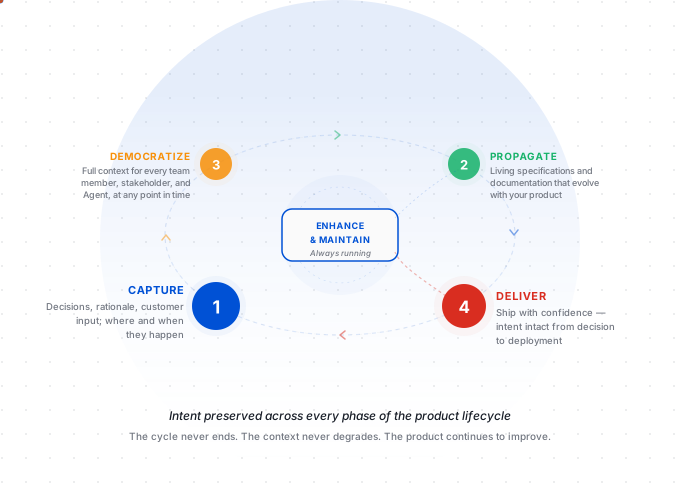
Conntinuum is an AI-enhanced product development platform built to deliver all four of these capabilities as an integrated system. The platform orchestrates specialized AI agents called Splines across the full product lifecycle — from intent capture through specifications, architecture, development, and deployment. Every Spline operates from a shared, continuously updated understanding of the product. Every output stays synchronized with the current truth. Every team member has access to the complete context of every decision ever made.
The intent gap is not inevitable. It is a structural problem with a structural solution. AI development tools have made the cost of ignoring it untenable. Conntinuum makes it solvable.
Speed and structure are not opposites. They are prerequisites for each other.
Keep Exploring Conntinuum
See what happens when AI builds on a solid foundation
Conntinuum captures product intent where it’s born and carries it intact through every phase of the lifecycle. The result is software built at AI speed on a foundation designed for what comes next.