Skip to content

How Conntinuum Works

One continuous thread, from first conversation to final commit.

Most platforms start at the backlog. Conntinuum starts at the conversation — and never lets go of the context that makes great products possible. Here's how the platform works across the entire lifecycle.

Step 1

Capture & Context

capture-and-context-graphic-1

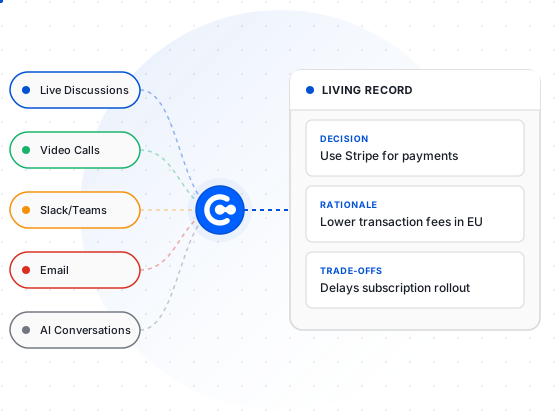
Your product vision starts in a conversation — a boardroom decision, a Slack thread, a Zoom call. Conntinuum's Splines — our specialized AI agents — show up wherever your team works and do far more than take notes. They ask the questions nobody thought to ask. They capture not just what was decided, but why.

They flag when a new decision conflicts with something agreed to six months ago. They surface relevant context from earlier in the product journey when it matters most. And they capture not just what was decided, but why — the rationale, the trade-offs, the strategic intent behind every choice.

Product development is long, complicated, and easy to lose the thread of. No single person on your team can hold the full context of every decision ever made. Your Splines can. Every conversation they join adds to a living record that's visible, traceable, and available to every stakeholder and every team member — from the first discovery session to the final sprint.

Nothing gets lost in translation. Nothing has to be re-explained. The institutional knowledge of your product lives in the system, not in someone's head.

Step 2

Specify & Refine

specify-and-refine-graphic-3-1

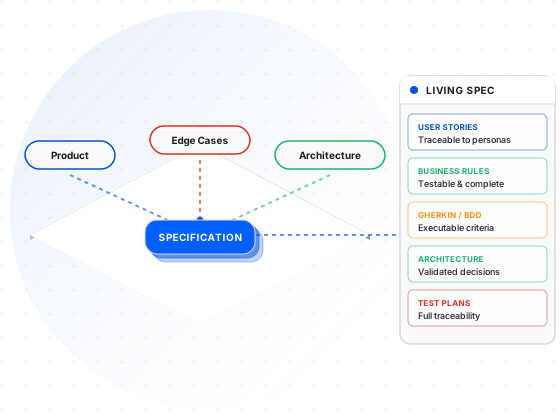
This is where Conntinuum diverges from every other tool on the market. From captured intent, your Splines produce a complete specification layer — feature requirements with testable business rules and executable Gherkin, system architecture validated against technical standards, data models, API contracts, security threat models, and comprehensive test plans. Every deliverable is interconnected. Every requirement is traceable. Every change propagates automatically.

Conntinuum's Splines don't just generate specifications once and hand them off. They maintain them. When intent evolves anywhere in the system — a decision made in a meeting, a refinement captured in a thread, a strategic pivot approved by leadership — that change propagates automatically across every connected deliverable: user personas, feature requirements, architecture decisions, acceptance criteria, test plans, and beyond.

Every artifact stays synchronized with the current truth of your product. No more chasing down which version of a spec is current. No more discovering mid-sprint that the requirements everyone was building from were updated two weeks ago and nobody told the team.

This is Spec-Driven Development. The specification isn't documentation you write after the fact. It's the artifact your product is built from.

This is what a genuinely living system looks like — not a document that gets outdated the moment it's written, but a specification layer that moves with your team, reflects reality at every stage of the journey, and ensures that every person building your product is always working from the same ground truth.

The Specification Layer

What a Conntinuum specification actually contains.

When we say "specification," we don't mean a requirements document someone writes and files away. A Conntinuum specification is a living, interconnected system of deliverables that together define your product completely:

Product Strategy

Vision Board, Ideal Customer Profiles, User Personas, prioritized Feature List — produced by ProductXplorer and its specialist Splines.
Feature Requirements

User stories with testable business rules, executable Gherkin acceptance criteria, and full BDD example mapping — produced by FRDXplorer and its Three Amigos pipeline.

Architecture

Technical standards, system design, data models, API contracts, security requirements, infrastructure specifications — produced by ArchitectXplorer and six specialist Splines.

Design

Screen specifications, interaction state machines, accessibility audits, design system tokens — produced by DesignXplorer and its specialist Splines.

Quality

Comprehensive test plans covering functional, API, security, accessibility, and performance testing, plus automation strategy and regression planning — produced by TestXplorer and nine specialist Splines.

Every deliverable links to every other deliverable. Change a persona, and the features that serve that persona are flagged. Change a business rule, and the test cases that validate it update. Change an API contract, and the security threat model is re-evaluated. This is what makes Spec-Driven Development possible — and it's what makes Conntinuum fundamentally different from tools that skip straight to code.

Step 3

Build, Ship & Evolve

build-ship-evolve-graphic-1

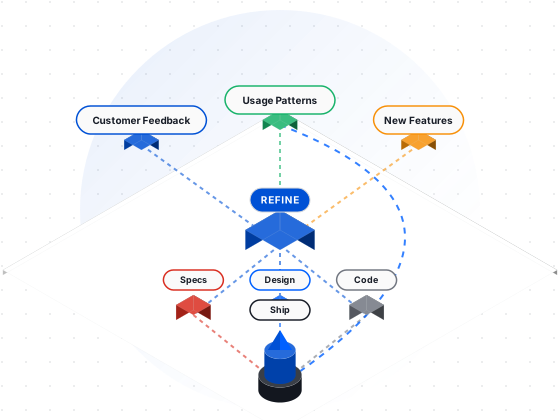
When specifications are this complete — with business rules, acceptance criteria, architecture decisions, data models, and test plans all interconnected — code generation stops being a gamble. Engineers aren't interpreting a prompt. They're implementing a specification that tells them exactly what to build, how it connects to everything else, and how to verify it works. CodeXplorer Splines generate code directly from these specs, producing implementations that are maintainable, testable, and traceable from the first commit.

But deployment isn't the finish line — it's where the feedback loop begins. Customer feedback, usage patterns, support signals, and new strategic decisions feed directly back into the system. Splines surface what users are actually asking for, reconcile it against your existing product context, and help your team make informed decisions about what to build next — and why.

Your product doesn't just ship. It compounds. Every release makes the next one smarter, faster, and more aligned with the people using it. Conntinuum doesn't hand you a finished product and walk away. It stays in the room for every conversation about what comes next.

This is the promise vibe coding tools make but can't deliver: fast software that's also good software. The difference is the specification layer underneath it.

Specs in hours. Sprints in days. Products in weeks.
From raw product idea to deployed software — AI-enhanced speed, human-driven decisions, enterprise-grade quality.

The Architecture

Specialized agents. Shared intelligence.

Conntinuum's Splines — our specialized AI agents — are organized into coordinated pipelines, each owning a phase of your product lifecycle. Every pipeline shares context with every other.

42+ Splines across 6 pipelines... and more coming online every week
6 Splines

Strategy & Discovery

Orchestrator: ProductXplorer

From a raw product idea to a complete strategic foundation — vision, audience, personas, features, and glossary — in a single working session.

6 Splines

Requirements & Specification

Orchestrator: FRDXplorer

User stories, business rules, and executable acceptance criteria — traceable to every upstream decision and maintained as living documents.

6 Splines

Design & Experience

Orchestrator: DesignXplorer

Design system, user flows, screen specs, interaction patterns, and WCAG accessibility audits — ready for Figma or direct implementation.

9 Splines

Architecture & Engineering

Orchestrator: ArchitectXplorer

Technical standards, system design, data models, API contracts, security requirements, and infrastructure specs — validated for cross-deliverable consistency.

10 Splines

Quality & Testing

Orchestrator: TestXplorer

Functional tests, API contracts, performance plans, security scenarios, accessibility verification, automation strategy, and regression suites — all traceable to requirements.

5+ Splines

Build & Deploy

In active development

Code review, PR management, test execution, repository scaffolding, and cloud provisioning — extending the network from specification into implementation.

Coming soon

Expanding Domains

New pipelines shipping continuously

Legacy modernization, product marketing, mobile publishing, cloud optimization, monitoring, pricing strategy — the Spline network keeps growing.

Works where you work

Deep Integrations

Conntinuum meets your team where decisions and activity already happen.

Conversations
Slack_icon_2019.svg
Slack
zoom-1
Zoom
teams
Teams
meet
Meet
gmail
Gmail
outlook
Outlook
users-01
In Person
Project Tools
notion-logo-no-background
Notion
linear-1
Linear
jira
Jira
confluence
Confluence
UI & UX Design
figma
Figma
paper
Paper
Development
github
GitHub
APP_ICON_3D_LIGHT
Cursor
GitLab
GitLab

The Methodology

Built on a framework, not just a feeling.

Every Spline output and deliverable associated with your product is built on the C3V framework — Conntinuum’s methodology for product development that ensures every deliverable meets a consistent standard of quality, clarity, and value. C3V isn’t a checklist. This isn't a vibe-coding solution that will produce different results every time you use with standards that aren't apparent or built for either the Enterprise or startups that need to scale. It’s the philosophy embedded in everything the platform produces.

Clarity

Every output is written so every stakeholder - human or machine, technical or non-technical - can understand it, act on it, and trace it back to the decision that created it. 

Collaboration

Built-in review workflows ensure that Product, Engineering, and Quality perspectives are represented in every deliverable - not just the loudest voice in the room. 

Craftsmanship

Quality gates ensure that every specification, requirement, and architectural decision meets the standard your engineers need to build from confidently. 

Value

Every feature, every decision, and every line of output must articulate measurable user or business value. If it doesn't serve the product and customer, it doesn't ship.